

Podcast: Play in new window
Subscribe: RSS
TOPIC: How being gentle can improve relationships
In last week's podcast episode, titled “What Most Couples Do That Creates Problems,” I talked about how couples tend to try and resolve their concerns through their partner.
In a short video by Dr. John Gottman (renowned relationship expert and researcher), he talks about this dynamic. In Gottman's language, he separates couples from his research into two major groups: the “masters” and the “disasters.”
Masters are the couples that are still happily together after six years. Disasters are the couples that are unhappy and/or are not together anymore.
When addressing an issue, masters are gentle in their approach with one another. Whereas, disasters tend to have the attitude of “diagnosing their partner's personality defects.”
Frequently, I talk about the importance of approaching a difficult conversation from a calm and caring place, in that it sets the conversation up for better communication. Couples will be more apt to listen and hear each other, and hence be a little more able to work towards a resolution together.
(Please listen to the podcast episode or read the transcript to hear more explanations, stories and examples.)
What is Gentleness?
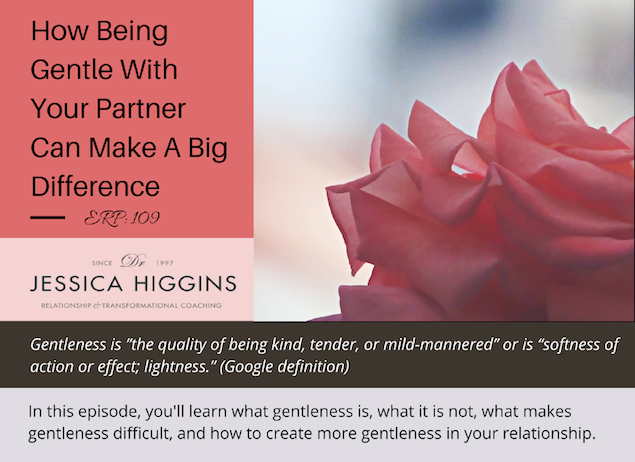
Google's definition of gentleness:
- ”the quality of being kind, tender, or mild-mannered.”
- “softness of action or effect; lightness.”
Why do we struggle with being gentle?
- We think being gentle is a gift or is for the benefit of our partner.
- We get angry and think our partner doesn’t deserve our kindness. Sometimes, we may even want to punish our partner a little bit.
- We are not gentle because we are protesting something our partner is doing, in hopes they will hear our plea and come to the rescue.
- We feel offended, slighted as if our partner doesn’t care and/or has hurt us purposely,
- We think our partner will not hear the severity of our concern if we are too gentle in our approach.
When in fact, the opposite is true. When we come on strong, our partner is often too busy managing their stress levels of feeling attacked. This is largely an automatic and biological function. If your partner is feeling worried, scared, insecure, and overwhelmed, chances are they will be more focused on trying to protect themselves rather than listening to what you have to say. This prevents communication because partners are not feeling safe, secure, and at ease.
We react to each other's nonverbal communication
Couples can react to each other within a nanosecond. It doesn’t take much…an eye roll…head nod…a sigh.
The majority of communication is nonverbal. Here is an excerpt from this article How Does Nonverbal Communication Affect Relationships?:
“Most of us remember cringing as children when our mothers gave us that look — the look that meant we were in deep trouble. She didn't have to say a word. And even if she did say a word — even if it was kind — you could probably still tell you were in trouble because the brain processes both verbal and nonverbal communication at the same time and notices when someone's words don't match their body language. A wealth of emotions can be conveyed with a look, a sigh, a smile or a tilt of the head. Nonverbal communication is not just something we do to show how we are feeling, but we also depend on our interpretations of it when we interact with each other.
Indication of trouble or upset in the relationship.
Nonverbal communication includes body language, tone of voice and facial expressions, all of which can be misinterpreted. When nonverbal cues are misinterpreted, it can create conflict in a relationship.”
When bothered by your partner, are you gentle in your approach?
When are you not gentle with your partner? What hinders your ability to be gentle?
- “When I feel stressed (pressed for time, tired, hungry or overwhelmed).”
- “When I think my partner knows better, and they do not care.”
- “When I feel scared or threatened.”
When are you able to be gentle? What helps?
- “When I feel good and strong.”
- “When I feel in connected with my partner.”
- “When I trust my partner cares, but just does not know what is going on for me.”
How to create more gentleness:
1. One of the best ways to set your communication up for success is to start off soft with your approach. This comes from being in a calm state and caring about having a positive outcome.
2. Prioritize gentleness throughout the conversation. This requires you to manage your stress level.
From Nonverbal Communication: “Stress compromises your ability to communicate. When you’re stressed out, you’re more likely to misread other people, send confusing or off-putting nonverbal signals, and lapse into unhealthy knee-jerk patterns of behavior. And remember: emotions are contagious. You being upset is very likely to make others upset, thus making a bad situation worse.
If you’re feeling overwhelmed by stress, it’s best to take a time out. Take a moment to calm down before you jump back into the conversation. Once you’ve regained your emotional equilibrium, you’ll be better equipped to deal with the situation in a positive way.”
3. Give your partner the benefit of the doubt. Trust they care. Being willing to participate in creating a climate of goodwill.
4. Let them know what happens for you, rather than what they are doing wrong. Talk about your experience – reveal your thoughts, worries, fears, and emotions (listen to episode ERP 108 for more information).
Practice step:
Ask yourself:
- When am I able to be gentle? What helps?
- When am I not gentle? What hinders?
If you have an issue to bring up with your partner, try to practice these 4 steps. Let me know how it goes!
Mentioned:
- ERP 108: What Most Couples Do That Creates Problems (podcast episode)
- Nine Destructive Behaviors to Avoid During Relationship Conflict (article)
- A Step-by-Step Guide To Turn Any Argument Into Effective Communication (article)
- ERP 074: How To Combat The Damage Of Stress In Your Relationship (podcast episode)
- ERP 075: How To Combat The Damage Of Stress In Your Relationship – Part Two (podcast episode)
- “Criticism” video with Dr. John Gottman (video)
- How Does Nonverbal Communication Affect Relationships? (article)
- Nonverbal Communication (article)
- East Beach Volleyball Academy (website)
- AVP (website)

TRANSCRIPT:
Click on this link to access the transcript for this episode: ERP 109: How Being Gentle With Your Partner Can Make a Big Difference [Transcript]
If you have a topic you would like me to discuss, please contact me by clicking on the “Ask Dr. Jessica Higgins” button here.
Thank you so much for your interest in improving your relationship. Learning how being gentle can improve relationships not only make better communication, it also allow couples to be themselves without the fear of getting emotionally rejected and freedom to show how deep they can express love.
Also, I would so appreciate your honest rating and review. Please leave a review by clicking here.
Thank you! ❤
0 Comments